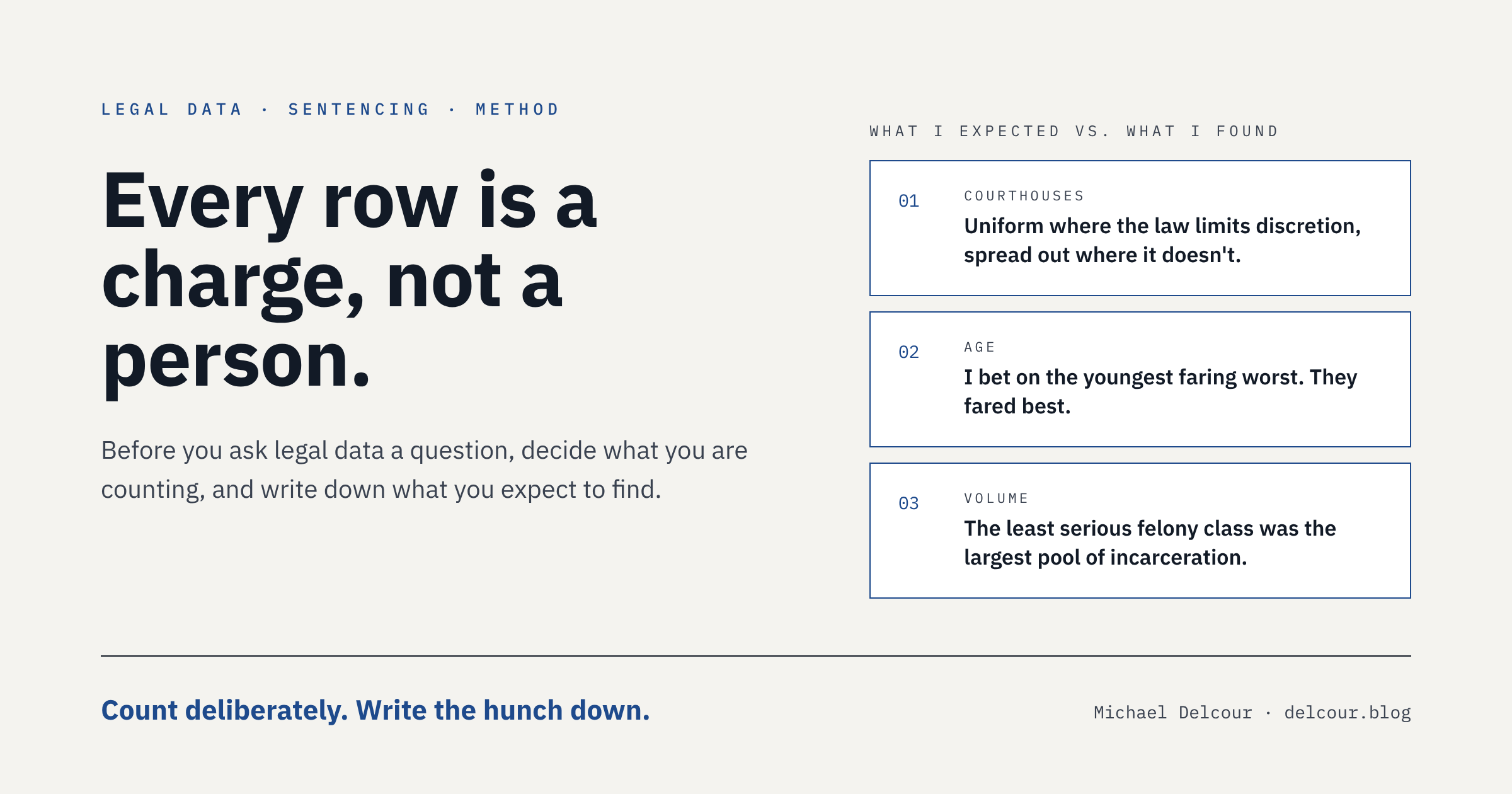
Every Row Is a Charge, Not a Person
What fifteen years of sentencing memos, one very large spreadsheet, and a list of my own biases taught me about asking honest questions of legal data.
For more than fifteen years I wrote sentencing memoranda in federal criminal cases, which is a peculiar genre of legal writing in which you try to persuade a judge that the person standing beside you is more than the worst thing they have done, and that the number on the guidelines worksheet does not tell the whole story. I got reasonably good at it. I also developed, as anyone does after that many years in the same courtrooms, a large and confident collection of opinions about how sentencing actually works, which judges are hard, which charges are punished out of proportion, and who tends to get the benefit of the doubt.
This fall, as part of a graduate data science program at Northwestern, I finally had the chance to test some of those opinions against something larger than my own memory. The Cook County State's Attorney's Office publishes its sentencing data on the county's open data portal, and the version I downloaded ran to 305,884 rows and 41 columns, covering sentences from 2011 through late 2024. Cook County was a jurisdiction where I had never practiced, which meant I knew the law but none of the local folklore, and that turned out to be a useful kind of ignorance.
I should say plainly what this was and was not. The assignment was an exercise in learning how to prepare, review, and analyze a large and genuinely messy dataset, the kind with impossible dates, inconsistent categories, and sentence lengths stored as text, and most of my hours went to cleaning rather than concluding. It was never meant to be a study of Cook County's courts, and nothing below should be read as a grand pronouncement about them. What it gave me instead was a set of lessons about method that I suspect will outlast any particular finding.
Two things happened before I produced a single chart that I think matter more than any of the charts themselves, and both apply well beyond criminal sentencing.
Read more