On Palantir, ethical walls, and the quiet virtue of letting each system do the one job it was built for.
Anyone who has thought about technology inside a law firm over the past couple of years has probably wandered, at some point, toward the same tempting idea. Legal data is scattered everywhere: matter files in the document management system, conflict rules with the risk team, a practice management database of an uncertain vintage, an HR roster, and an archive of motions and briefs going back to the era of WordPerfect. Why not put all of it in one place, under one intelligent roof?
That is, more or less, the pitch for Palantir Foundry and its AI Platform. You load your separate systems into one shared data model (Palantir calls it the Ontology), attach security markings worthy of a defense contractor to every record, and build AI agents on top of the whole thing. On paper it is hard to resist. You own the data model, you own the permissions, and you are not beholden to anyone else's application.
Then you think about what it would take to run it in an actual law firm, with actual partners, on an actual budget.
I have not merely imagined it. For about fifteen years I was senior counsel and technology director at a litigation firm, where part of my job was designing ethical wall and privilege protocols, and for most of that same stretch I also ran an ERP consulting practice, moving companies between Sage, SAP, and NetSuite. Doing both at once taught me a good deal about time management and left me permanently suspicious of anything sold as the one system to rule them all. More recently I have used Palantir AIP in a nonprofit setting for a narrow purpose that had nothing to do with legal drafting. I have also spent a fair amount of time with the legal AI vendors.
Working with Foundry, even in that one small corner, left me with real respect for what it can do and a clear sense of how much it asks of the people who run it. If the goal is to give a litigator a tool that reads discovery and drafts a motion while respecting the firm's precedent library, building it on Palantir means solving a fairly specific problem in about the hardest and most expensive way available.
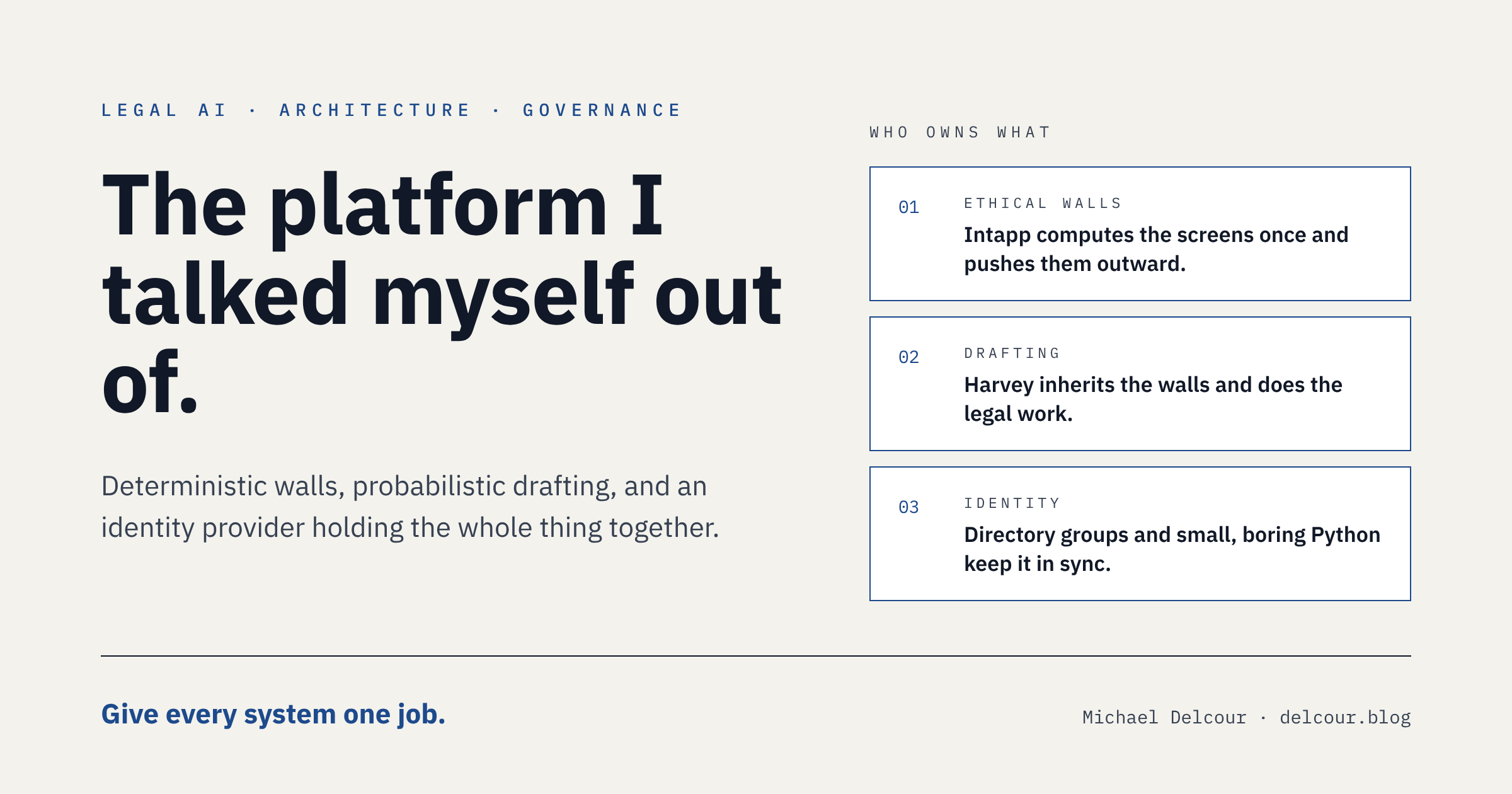
What most firms need, I have come to believe, is a sensible division of labor. Let Intapp Walls handle the ethical barriers, let Harvey handle the legal drafting, and let your existing identity provider (plus a modest amount of custom code) hold the rest together.
Training Versus Access
Before lawyers and general counsel will trust any of this, you have to clear away the most stubborn misunderstanding in legal AI: the belief that the firm's documents get "trained" into the model.
When partners hear that an AI tool will draw on the firm's motions database to help draft a new brief, their first worry is data bleed. If an associate puts a sensitive discovery document or a privileged memo into the system today, will Client A's confidential facts turn up in a draft for Client B next month? And if a brief has a few privileged paragraphs buried among perfectly good boilerplate, does someone have to teach the model to look away from the sensitive parts?
Nobody trains a model to avert its eyes from privileged text. In legal AI, protecting privilege comes down to who can retrieve what, and it has very little to do with the model's education.
Modern legal AI tools do not bake your work product into the model itself. They use a method called retrieval-augmented generation (RAG). When a drafting task runs, the tool pulls the relevant passages from approved sources, hands them to the model for that one task, and lets them go when the session ends.
Once you accept that the AI reads documents at the moment you ask rather than memorizing them, the question rearranges itself. You are no longer trying to teach legal ethics to a neural network (a project I would not wish on anyone). You are making sure the AI never lays a finger on a file the user is not allowed to see, and that is a problem law firms already know how to solve.
When the Platform Becomes the Overhead
This is where Palantir looks its best. Foundry's data model is designed to sit across separate systems, pulling employment status from HR, matter numbers from finance, and conflict flags from the risk database, and to control access down to individual fields. An AI agent working inside it automatically follows those rules, which is genuinely elegant.
The trouble begins once the security is working.
Palantir is built to run supply chains, military logistics, and hospital operations, where decisions get written back into many systems at once. It gives you the parts to build almost anything, which is a lovely gift right up until you realize it also makes you responsible for building everything.
To recreate a modern legal drafting tool inside Palantir, an in-house engineering team would have to build, and then maintain indefinitely:
- A way to read messy litigation PDFs, deposition transcripts, and Word documents that have been edited by eleven people across four versions of Office.
- Citation checking and safeguards against invented case law.
- Matter workspaces that make sense to practicing lawyers, who have strong (and well-earned) opinions about software that feels as though it was designed for data engineers.
- Ongoing testing and adjustment every time the underlying AI model changes, which is to say constantly.
The likely result is a substantial infrastructure commitment, followed by months of engineering work to recreate features that legal AI tools already ship. Unless what you really want is a live command center that blends financial data, staffing, and case intake and acts on it automatically across your legacy databases, Palantir is an enormous amount of machinery to carry for the privilege of drafting a motion.
Splitting the Stack
The cleaner approach, and one the market has started moving toward, draws a firm line between the security rules, which should give the same answer every time, and the AI, which by design does not.
Let Intapp Own the Ethical Walls
In a large firm, an ethical screen (whether it comes from Model Rule 1.10 or a client's outside counsel guidelines) is not worth much if it only lives in a compliance memo that everyone dutifully filed and nobody read. For years Intapp Walls has been the tool that turns conflict rules into actual access restrictions in document systems like iManage and NetDocuments.
Those walls, however, used to stop at the edge of the document system, and generative AI arrived to exploit that gap with admirable efficiency. An associate with legitimate access to a restricted matter could download a file, drop it into a shared AI workspace, and, without any ill intent, expose it to a colleague who was supposed to be screened off.
Intapp Walls for AI, along with its Harvey integration announced in February 2026, is aimed squarely at closing that gap. Intapp stays the single, auditable source of truth. It takes in HR changes, lateral-hire screens, and matter data, works out who can see what, and pushes those rules out to the tools where the work now happens.
Let Harvey Own the Legal Work
Because Harvey connects to Intapp Walls, it does not need to keep its own competing set of ethical barriers. It simply inherits Intapp's. If an attorney is screened from a matter in Intapp, that screen follows them into Harvey's Assistant, its Vaults, and its shared workspaces. If Harvey cannot confirm that access is allowed, it is designed to refuse, which is exactly the posture you want from anything standing between a lawyer and a conflict.
Splitting the stack also answers the practical puzzle of how an AI tool can draft a motion from discovery without leaking privileged precedent. The data goes into two buckets, each with its own rules.
The discovery bucket. Raw, unredacted discovery for an active case goes into a locked Vault for that matter, governed by Intapp Walls. There is no need to anonymize it, because only the authorized litigation team can get in, and privilege is protected the same way it would be in a properly locked folder in the document system.
The precedent bucket. No one should expect an AI to politely ignore the privileged paragraphs in an unredacted brief that someone tossed into a firm-wide database. Instead, the knowledge management team curates a set of model documents, either motions that have already been publicly filed or briefs with client-identifying facts removed, and places them in a firm-wide library.
When the drafting tool runs, it takes the facts only from the locked discovery Vault and takes structure, tone, and legal standards from the cleaned-up precedent library. The firm gets legal drafting without anyone writing a single line of custom Palantir code, which I suspect will be a relief to all parties.
The Identity Glue
No law firm, of course, runs on Intapp and Harvey alone. There are still case management systems (LegalServer in legal aid, and billing systems of varying antiquity in large firms), general AI tools like Claude for technical and operational work, HR software, and accounting software, none of which were introduced to one another at birth.
So how do you keep permissions in sync across all of them? To start, an AI tool should never be the one deciding who can see what. AI is wonderful at summarizing a deposition and temperamentally unsuited to enforcing access rules that have to come out the same way every time. The identity provider, whether Microsoft Entra ID or Google Workspace, is far better suited to the job.
Even with Google Workspace, which is less capable than Entra ID at automatically pushing groups out to other applications, the plumbing can stay rather light.
- Standardize on directory groups. Use Google Groups (or Entra security groups) as the official record of who has access to what, and name them clearly by role, program, and ethical wall so the next administrator does not need an forensic accountant to interpret them.
- Pass group membership at login. Many cloud tools can read a user's groups when they sign in through SAML and set their permissions to match. Confirm what each vendor actually supports before you design around it.
- Connect the older systems with small scripts. Some case management systems handle sign-in through SAML but manage case-level permissions separately. A scheduled Python script that reads group membership from Google's directory and updates the case management system through its API will keep the two in step, predictably and with a record of every change, and boring is the highest compliment one can pay to code that controls access.
What the Split Stack Costs You
None of this comes free, and an architecture argument that pretends otherwise deserves intense scrutiny.
The first cost is dependence. When Intapp owns your walls and Harvey owns your drafting, your security rests on a partnership between two companies that is still young, and your roadmap quietly starts to depend on theirs. I would want to know what happens when the integration hiccups, have an exit plan for the day either vendor changes its pricing or its priorities, and get in writing how long prompts and outputs are kept. "Discarded at the end of the session" is a design goal, and it belongs in the contract.
The second cost is money, and here my legal aid colleagues are already smiling ruefully. Harvey and Intapp are priced for firms that bill by the hour, and a nonprofit that budgets grant by grant cannot simply buy its way into this setup. A firm already committed to Microsoft will also fairly ask whether Copilot, which inherits permissions from SharePoint and Entra, can cover much of the same ground for less.
The encouraging part is that the principles hold up even when the product names change. Keep access control out of the AI. Make the identity provider the source of truth for who belongs where. Keep each matter's evidence separate from the curated precedent that teaches structure and tone. Write small scripts you can audit instead of building a sprawling platform. A legal aid organization can follow every one of those rules with tools it already owns, a large firm can follow them with Intapp and Harvey, and both will end up with something their lawyers can trust.
Buying Focus Instead of Building Infrastructure
Choosing a split setup over a Palantir-centered one is, I would argue, an exercise in restraint, which is a less glamorous virtue than ambition but one that tends to look a lot better in the budget.
Palantir is an extraordinary piece of engineering for organizations that genuinely need a live model of their entire operation that can act on its own. Most legal organizations have a humbler and more pressing goal. They want their lawyers to produce better work faster without breaching an ethical wall, running afoul of a client's outside counsel guidelines, or quietly turning the IT department into a full-time AI engineering shop.
Let Intapp enforce the rules, let Harvey do the drafting, and let your identity provider and a few hundred lines of carefully unremarkable Python bridge the gaps. You shed a great deal of licensing and maintenance weight, and every system is left doing the job it was built to do.