The stories coming out of the iPhone Duo launch paint a grim tableau: someone lifts a very expensive folding phone out of an elegant box, opens it as though it were a booby-trapped relic, and then the boulder comes rolling (or, less cinematically, the screen has already cracked). Reading enough of them returned me to a question I have been turning over since the day Apple blocked my Haxies: has Apple fundamentally changed, or is it simply doing what it has always done, only now with a hinge?
Having spent more of my adult life inside Apple's ecosystem than I would care to total up, I have come to believe the answer is both. On the hardware side, Apple is repeating a pattern that stretches back decades, and anyone who has been paying attention should find it more familiar than shocking. What has changed is the layer of human care that used to sit beneath those products and catch us when they failed, and the slow disappearance of that layer tells us a good deal about where the rest of the technology industry is heading, now that every company on earth has discovered AI.
The Myth of the Finished Product
Apple's greatest marketing achievement may not be any single product but the long and remarkably successful campaign to persuade the public that whenever it arrives late to a category, it is being disciplined rather than slow. For years, Samsung and Google have taken the creative leaps in public, stumbling through the awkward adolescence of foldable phones, flexible displays, and AI assistants while Apple watched from the balcony. The implied promise is that Apple waits until a technology has matured, so that its customers only ever touch the finished and perfected version.
It is a lovely story, and it is mostly untrue. Apple has been late to plenty of shifts, from foldables to touchscreen laptops to lightweight augmented reality glasses to artificial intelligence itself, and arriving late has never once prevented it from shipping something unfinished.
The history here is long and rather colorful. Even under Steve Jobs, the iPhone 4 shipped with an antenna that dropped calls if you had the temerity to hold it like a phone, a problem Apple first answered by suggesting that customers hold it differently. In 2017 I lived through the butterfly keyboard era personally, surrendering my MacBook for a keyboard replacement because Apple had spent years selling a design that could be defeated by a single, sufficiently determined speck of dust. We have watched more than one generation of Mac Pro, and now the Vision Pro, arrive with breathtaking price tags and grander promises, only to be left on the vine long before they had any chance to ripen.
Seen in that light, a folding iPhone with fragile screens is less a scandal than a rite of passage. Apple has always lived a good deal closer to the edge of a disastrous launch than its reputation would have you believe.
Living With Three Different Apples
If the track record is so full of contradictions, it is fair to ask why so many of us stay. My own answer is that modern Apple is really three companies sharing a logo, and I have very different relationships with each of them.
The first, the one that makes phones, tablets, and the little box under the television, I left a long time ago. A Google Pixel lives in my pocket and a Samsung tablet comes out when I want a smaller screen, because iOS, iPadOS, and tvOS have felt stagnant and boxed in for years while their competitors have been willing to try things, and occasionally even good things.
The second makes the Mac, and that one I have never managed to leave. I bought my first MacBook in college and have not seriously looked back, and even now, writing this on a MacBook Pro whose motherboard was rebuilt earlier this year, I remain unreasonably fond of it. Apple Silicon handles whatever I throw at it without complaint, and macOS is, to my mind, the best operating system yet devised for a day of real work, polished in ways Windows has never quite managed and configurable enough for serious technical work without becoming a second job of its own.
The software and silicon engineering behind the Mac remain world class. The trouble lies with the third company, the one responsible for what happens after the sale, which has not kept pace with the other two at precisely the moment when the hardware tolerances across the whole lineup have grown a little sketchier than anyone should be comfortable with at these prices.
The Safety Net That Made the Risk Worth Taking
Look back across Apple's history of hardware failures and the difference between then and now is plainly not that the products used to be flawless, because they never were. The difference lies in how Apple treated you when they broke.
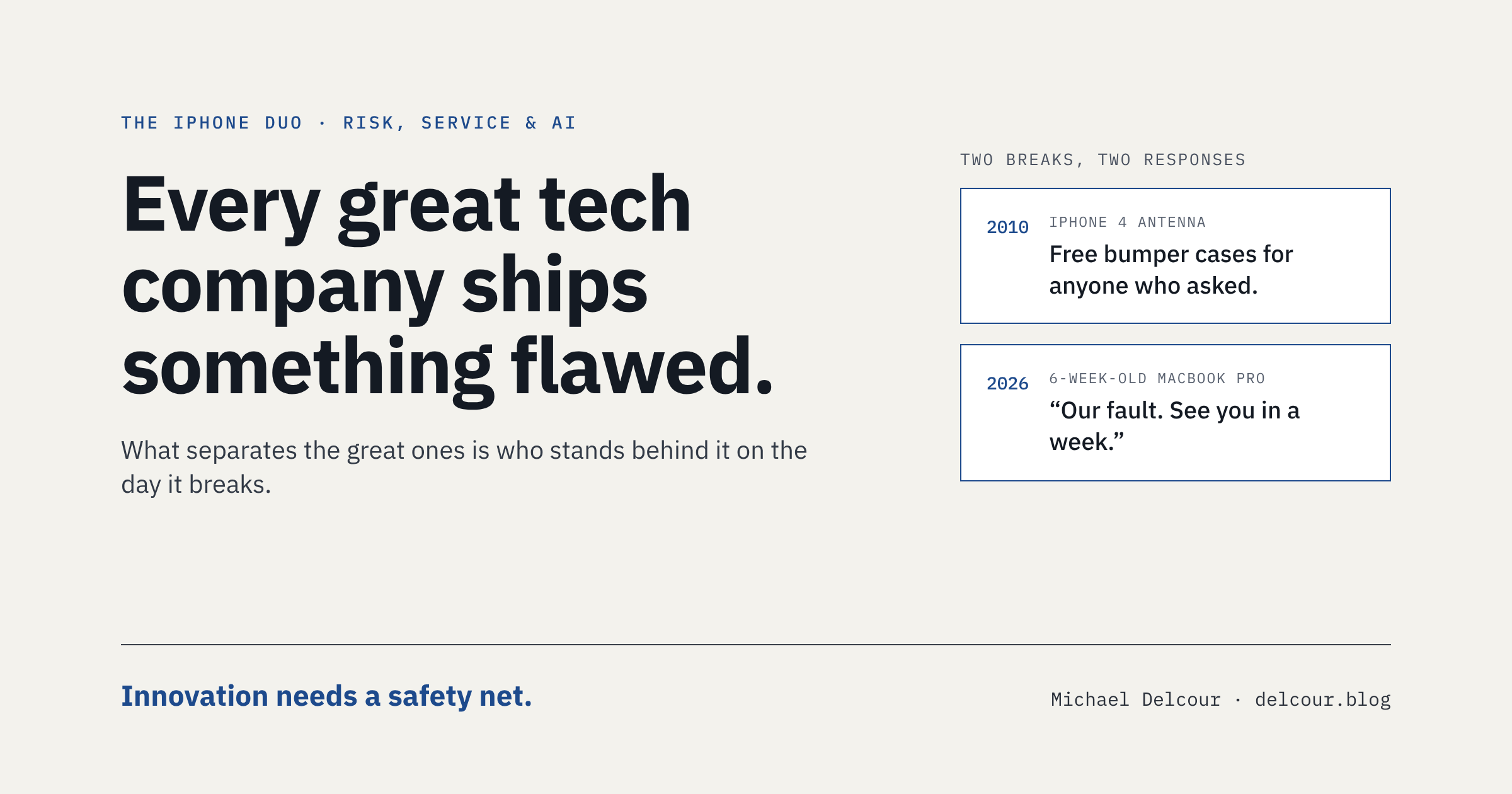
When Apple first opened its retail stores during my college years, the service was extraordinary. It was designed to cultivate a loyalty that bordered on the devotional, and it worked because the company stood behind its machines without a great deal of fuss. A technician at the counter had the authority to swap a bad machine or fix it on the spot, and knowing that gave customers a kind of faith in the company. That faith, in turn, gave Apple room to take real engineering risks, because a customer who trusts that a failure will be made right is a customer willing to buy the ambitious and slightly unproven thing. Even antennagate ended, once the advice about how to hold one's phone had been retired, with Apple handing out free bumper cases to anyone who asked. That is what a safety net looks like.
Somewhere in the years after Steve Jobs died, Apple evolved from a computer company with fanatical customer support into a luxury brand, and walking into an Apple Store today feels rather like walking into a high-end car dealership. It is a showroom first and foremost. The people on the floor have far less authority to solve a problem, almost nothing is repaired in the building, and accountability is boxed up and shipped off to a distant depot.
I learned the difference earlier this year, when the motherboard in my brand-new MacBook Pro died at the ripe old age of six weeks. Because nearly everything in a modern MacBook is soldered to a single board, one failure bricks the entire machine. I carried a six-week-old flagship laptop into the store expecting, perhaps naively, that they would hand me a working one in exchange for the lemon they had sold me. What I received instead was a polite shrug, which translated roughly to: yes, this is our fault, and yes, we will fix it, and you will be spending the next week without a computer.
The Irony of Insuring Perfection
It is worth admiring, if only professionally, the sleight of hand involved. Apple first persuaded the world that its products deserve a substantial premium because the engineering is supposedly years ahead of everyone else's. It then persuaded millions of those same customers to pay hundreds of dollars more for AppleCare, which is to say, to insure themselves against the failure of technology they had been assured was very nearly incapable of failing.
A company that collects both a perfection tax and an insurance premium has taken on an obligation to provide service at the level that earned its reputation in the first place. When it takes someone's primary tool, admits the failure is its own, and then invites them to work out how to do their job without it for a week, it has broken that bargain. And without exceptional service behind the counter, there is not much left to distinguish Apple from any other hardware maker, since under the aluminum they are all wrestling with the same supply chains and the same stubborn laws of physics.
The Bigger Question for the AI Era
I have spent my career as a legal technologist evaluating systems, building data tools, and talking with organizations about why some technology takes root while some quietly withers on the shelf, and I see this same dilemma playing out across the industry right now, nowhere more visibly than in AI. I should say plainly that I am an enthusiast here. I use these tools every day, I build with them, and I think they are going to make legal work faster and considerably less tedious than the profession has any right to expect.
What worries me is a particular sales pitch that has grown up around it. Every vendor would like to sell the vision of a seamless tool that never makes a mistake, and a good many of those same companies are quietly using AI to hollow out their service organizations, replacing capable, empowered people with chatbots and ticket queues that seem to lead nowhere in particular. In legal, where a hallucinated citation can find its way in front of a judge, that is hardly an abstract trade.
If Apple's trajectory demonstrates anything, it is that a company cannot have it both ways for very long. Innovation is untidy by nature, and the cracked screens and failed motherboards of the hardware world have a close cousin in the confidently wrong answers of a language model. That is no argument for slowing down, any more than antennagate was an argument against the iPhone. It is an argument for putting the right people in the loop. AI is extraordinarily good at drafting, sorting, summarizing, and spotting patterns at a scale no team of humans could match, and it is not yet in a position to decide what a client's matter needs, which risks are worth taking, or when a beautifully formatted answer is quietly wrong. Those remain judgment calls, and judgment calls need someone with the experience to make them and the standing to own them.
So I want technology companies, legal technology companies very much included, to keep reaching, and to keep pushing at the edges of what hardware and software can do, because the alternative is a very polished stagnation that I have already walked away from once. But if they want their customers, and particularly their enterprise customers, to take that leap alongside them, they have to underwrite the risk with real people who are empowered to make things right. Every great technology company eventually ships something flawed. What separates the great ones is whether, on the day it breaks, there is still someone behind the counter with both the authority and the inclination to stand behind it.