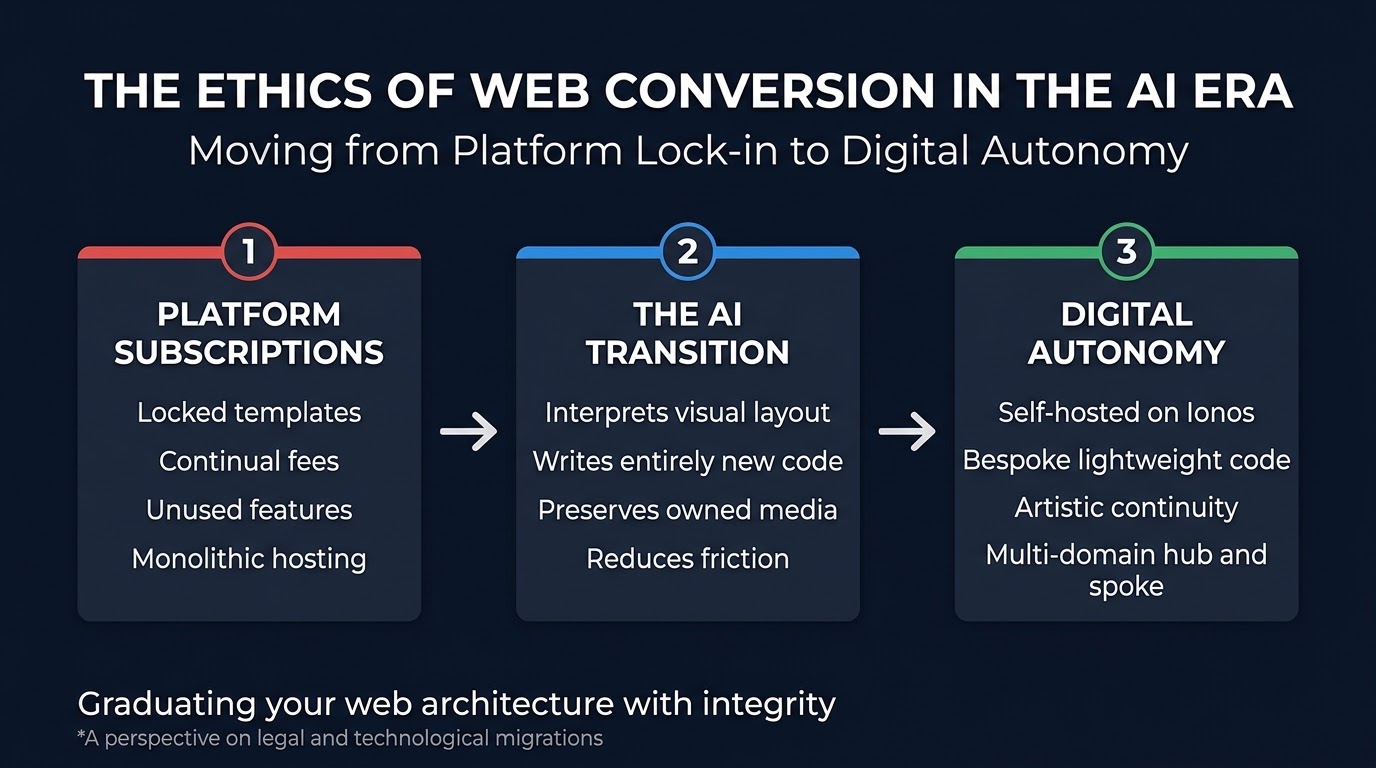
Generative AI has fundamentally changed the friction of writing code. Recently, I looked at a few websites I built with subscription site builders and considered the ethics of using an LLM to convert those visual designs into independently hosted HTML.
As someone who builds technical infrastructure for legal environments, I find this to be a significant ethical gray area that is coming up more often as AI tools make coding tasks more accessible. AI makes it incredibly easy to feed a screenshot to a model like Claude and ask it to interpret the visual layout. It is crucial to note that Claude is not copying or scraping the underlying source code. It simply looks at the site's general aesthetic and writes entirely new code from scratch. Still, this capability forces us to separate the strict legal right to copy from the ethical obligations we owe to developers and designers.
When you buy a traditional web theme, you pay for the license. Your conscience is clear if you outgrow the platform and want to expand your website using the theme as a template. But modern platforms sell access and convenience through endless subscriptions. If you use AI to transition your visual layout away from their infrastructure, it can feel like breaking a lease and taking the appliances with you.
The tension usually centers on the difference between exact replication and inspiration. If you prompt an AI to create an exact clone of a proprietary template just to avoid a hosting fee, that crosses a clear line. You are explicitly taking another human being's design decisions to bypass their compensation.
However, there is another angle to consider. Sometimes our technical requirements outgrow closed builders, and sometimes our actual needs shrink past what the platform offers. I realized I was no longer using the core features my host provided. I did not need simple drag-and-drop tools to constantly output new elements because what was once a functional interactive site had essentially become a static business card. Add my need for programmatic updates across multiple domains to manage a hub-and-spoke architecture for my professional presence, and the closed ecosystem simply couldn't support my workflow.
When you reach that point, you are not stealing. You are graduating.
The ethical compromise I settled on is treating those original templates as a mood board rather than a strict blueprint. I chose to look at the clean aesthetic of a site I paid to host for years, acknowledge the inspiration, and then direct the AI to build a new, unified design system that actually serves my technical reality. Furthermore, it is important to remember that I already own all the media, images, and other copyrighted content populated within these sites. I am simply migrating my own intellectual property into a new framework and trying to maintain artistic and functional consistency through the migration.
Ultimately, I think this is a personal choice as long as copyrights are not being violated. We all must give credit where credit is due and acknowledge the human curation that inspired our work. But we also have the right to claim digital autonomy and build the infrastructure we actually need.
Please note that while I am a licensed attorney in Illinois and Colorado, the thoughts shared in this article are for informational and conversational purposes only and do not constitute legal advice.